What is an electric car charging curve?
Plugged into a charger but can’t understand why the power you’re getting isn’t as high as you were expecting?
The chances are it’s because of the electric car charging curve. It’s not something you can see but it’s happening in your EV battery.
Let us explain…
EV charging curve explained
Imagine the scenario: your car is able to charge at 150kW and you’re plugged into one of our High Power chargers, capable of 350kW. That means you should see 150kW displayed on the screen as soon as you plug in, right? Not so fast. When you plug into any electric vehicle charger it isn’t like flicking a light switch and that’s because of the chemical make-up of the lithium-ion batteries in your car. What actually happens when you plug in, is that the electric vehicle battery will initially pull charge at a slower rate before increasing to hit its maximum charging power during the charging session. At this point, it’s probably worthwhile explaining that the charging curve is not just an electric cars thing. Your smartphone or laptop, both powered by lithium-ion batteries, do the same thing.
Why doesn’t EV charging power remain throughout the duration of my charge?
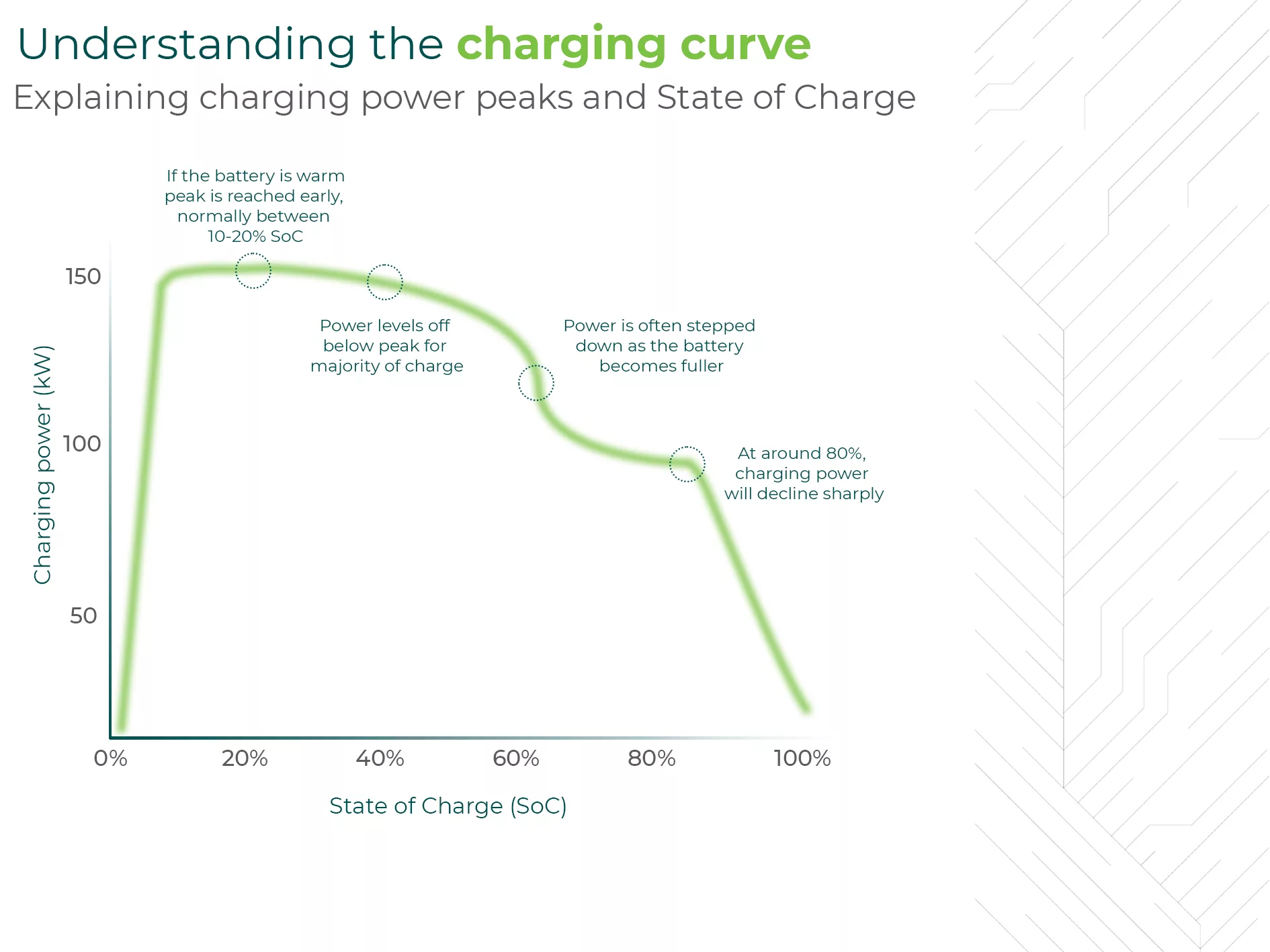
Ok, so you’ve got the basics but there’s more. Fortunately, we can ditch the GCSE chemistry lesson for a moment and crack open a bottle of red to explain. We’ve explained that you won’t achieve max power straight away – just like pouring a glass of wine, the start is always a bit slow while you find your aim. Once established, it’s full steam ahead as you fill the glass and then, because you don’t want to spill any claret, you naturally slow down and finish with a slow drip. This is mimicked by your battery charge. You’ll see the peak rate achieved before the power flattens off slightly and is maintained for the majority of the time you’re plugged in. As the battery approaches full, the power will start to reduce. Hence the name charging curve. Good to remember that the hand on the bottle is the car. The car sets the charging power (not the charger) and adjusts it to the level that is just right for the battery cells, considering the temperature and condition of the battery at the time. The EV charging curve and power you’ll receive is also directly tied to the State of Charge (SoC) of your battery. It’s a fancy name for battery percentage.Why 20 to 80% is plenty
Think of that wine glass again. You’re always quicker topping up a glass then pouring into an empty one. But if it’s too full, you won’t be so carefree either. The same is true of your battery. Plug in with very little battery remaining and the car will charge slowly until you reach around 10-20%. At this point the power will increase sharply to its peak. From here, several things can happen depending on the car (see more on this below). You might find the high power stays for the majority of the charging session, it may immediately drop a little and then hold this for a long period, or you’ll find power is stepped down at increments as your battery gets increasingly full. Then, when you get to around 80%, the EV charging curve will sharply drop to avoid battery cell voltages exceeding their limit and to avoid overheating (or spilling your Merlot). This is why we always recommend unplugging and heading back on the road once you reach 80%. You’ll be waiting much longer to add those final few percentage points, which could be blocking the charger for another EV driver. And for you, in the long run it’ll be faster to unplug and recharge later once the battery percentage has fallen to a point where the charging curve allows you to achieve higher power once again.