Electric cars feel pretty well established now. Your neighbour’s got one, your Mum’s got one. But electric trucks? The machines that keep Britain stocked, built and fed? They’re at the beginning of their electric chapter.
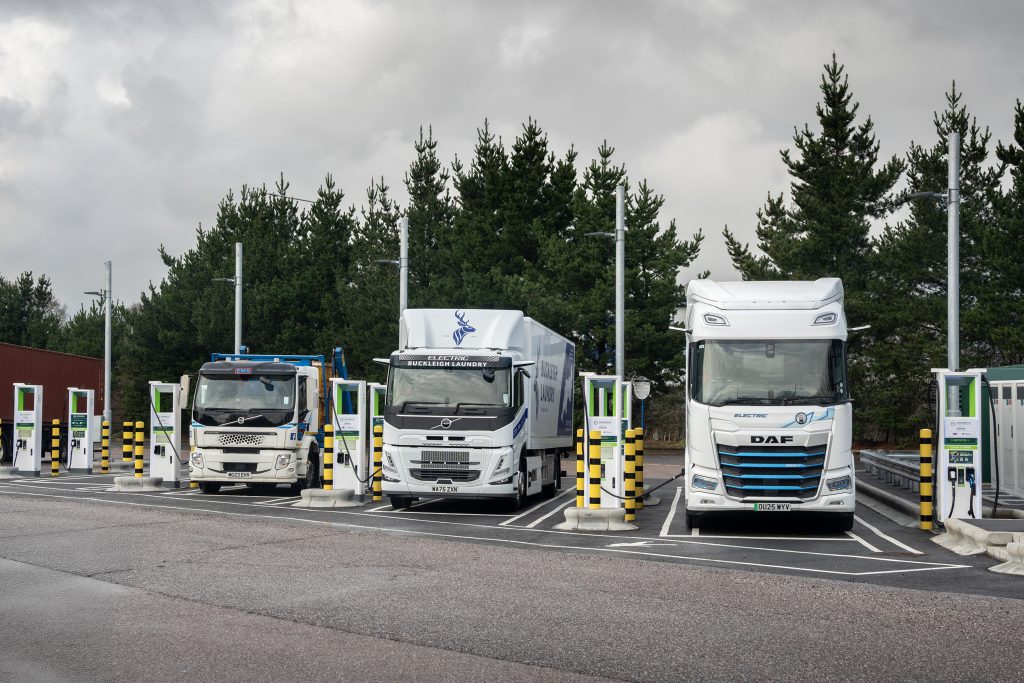
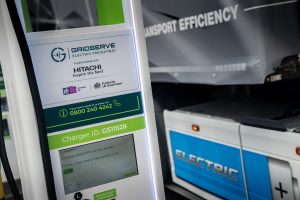
That chapter officially started today, with GRIDSERVE opening two of the UK’s first public electric HGV (eHGV) charging hubs as part of its Electric Freightway project. In plain English: electric lorries can now charge up at motorway services, just like cars do.
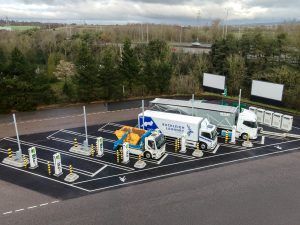
The first hubs are now live at Extra Baldock (J10 of the A1(M)) and Moto Exeter (J30 of the M5), with seven more locations in build and scheduled to open later this year. These aren’t pilot projects hidden behind factory gates. They’re public, high power and designed specifically for heavy goods vehicles to charge quickly, which is a big deal for an industry that runs on tight schedules and tighter margins.
Why trucks matter (and why electrifying them really matters)
HGVs may account for just 1% of vehicles on UK roads, but according to the Road Haulage Association, they’re responsible for transporting nearly 90% of all domestic goods. Less impressively, they also contribute 16% of domestic transport greenhouse gas emissions, which makes makes freight one of the most important pieces of the decarbonisation puzzle.
The government-backed ZEHID programme, funded by the Department of Transport and delivered with Innovate UK, was created to tackle exactly this challenge. One of its four funded projects is the Electric Freightway, led by GRIDSERVE, and supported by a 25-strong consortium of truck manufacturers, hauliers and logistics operators.
And now, after a lot of hard work, there are actual high-power chargers in places where trucks already stop.
“This is a proud day for the Electric Freigthway and indeed for the UK,” said Sam Clarke, head of the Electric Freightway programme. “This is the start of a nationwide network for electric trucks as we support the decarbonization of the largest vehicles in road transport.”
Built properly, for proper trucks
Extra Baldock opens with six dedicated eHGV charging bays, while Moto Exeter launches with four. All are drive-through lanes that are able to accommodate the largest of loads, meaning no three-point turns, no unhooking trailers and no accidental demolition of a Costa. You just drive in, plug in and leave again — regardless of where the charging port is on your particular leviathan.
The team have conducted swept-path analyses at each site, designed new lighting schemes and installed a 350kW-capable charger on both sides as there remains no conformity on the location of the charging port (as if it wasn’t hard enough as it is). In short, it’s been designed by people who understand that trucks are not just big cars. They’re their own ecosystem where failure to charge is not an option.
A real-world electric haul
To mark the opening, GRIDSERVE worked with DAF and its award-winning XF Electric – including the 2026 International Truck of the Year – to complete the motorway run from Moto Exeter to Extra Baldock, before photobombing the ribbon-cutting moment attended by members of the Department of Transport. That’s a real motorway route with hills, rain and presumably roadworks, and it accomplished it all with little theatrics.
Daniel Kunkel, GRIDSERVE’s CEO, summed it up neatly: “Electric freight isn’t some distant future concept anymore, it’s a live, operational reality. The same company that gave us the Electric Highway for cars is now doing the same thing for trucks.”
Is this the beginning of the end for diesel trucks? We like to think so, but there’s a long way to go. The UK government plans to phase out the sale of new non-zero-emission HGVs up to 26 tonnes by 2035, and all new non-zero-emission HGVs by 2040. Which means this charging network isn’t just a nice idea, it’s necessary.
With the opening of these first public eHGV charging hubs, the freight industry has taken a significant step toward a cleaner future. One that keeps goods moving efficiently, reliably and responsibly.
No drama. No gimmicks. Just progress.